Workshop-ready guidance for MIG, TIG, stick and plasma setups Talk with a welding advisor
Contact Hobart equipment guidance

Bring your welding job details to Hobart

Share the base metal, thickness range, joint position, available voltage, target process and expected arc-on time. These details help route the conversation toward a suitable equipment class and the manual tables that still require verification. Photos of the joint and a representative coupon can add useful context.

01

Dealer conversation

Use the form to prepare a machine comparison. Include your location so availability and electrical context can be discussed. A productive request names the joint instead of asking for the most powerful machine: mild-steel sheet, stainless tube, structural repair or another defined task.

Send job details
02

Technical preparation

Have the model manual, machine nameplate and consumable classification available. Never rely on a generic setting when the procedure specifies otherwise. If comparing duty cycle, record the amperage and percentage together because the percentage alone does not describe rated output.

Open the selection worksheet
03

Response context

Questions are reviewed in normal business workflow. Urgent safety, electrical or code issues belong with a qualified local professional. Dealer availability, accessory fit, regional electrical supply and applicable warranty terms also require confirmation at the point of purchase.

Review service paths
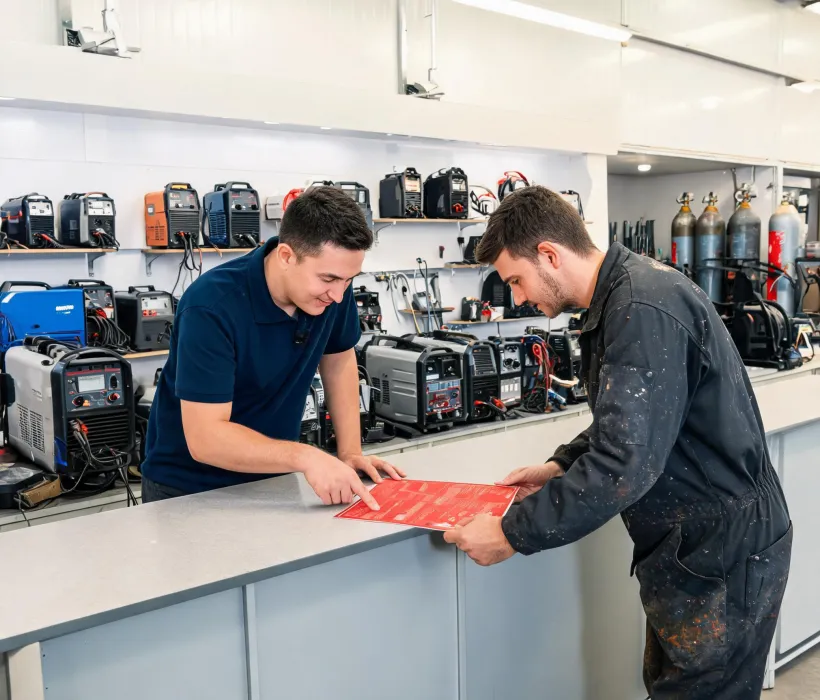
Welding advisor at a dealer counter

A useful request includes six facts

  • Base metal and thickness
  • Joint type and position
  • Indoor or outdoor environment
  • Available input voltage and circuit
  • Preferred process and consumable
  • Estimated arc-on time

Final selection remains subject to the specific model manual, applicable welding procedure and local electrical and safety requirements. Where code work is involved, include the governing standard and acceptance criteria. For aluminum wire feeding, describe gun length and expected wire diameter; for outdoor work, state whether shielding gas can be protected from wind.

Do not send passwords, payment-card data or controlled project drawings. A representative coupon and a written setup record provide a safer verification route than learning on the finished component.